Your Klaviyo flows are live. Now what?
There’s a very satisfying moment when you finally get all your Klaviyo flows built.
Welcome flow? Done.
Abandoned cart? Done.
Post-purchase? Done.
You switch them live, give yourself a little pat on the back and let them get on with making you money.
And then… you actually need to look at them again.
Because building your flows is only the beginning.
The really good stuff starts once they've been live long enough to give you some data.
Now you can see what customers are actually doing, what's making money, where they're dropping off and what could work harder.
And that's where Klaviyo optimisation comes in.
What is Klaviyo flow optimisation?
Klaviyo flow optimisation is the process of regularly reviewing the performance of your automated emails and making changes based on what your customers are actually doing.
That might mean changing the timing of an email, testing a different message, updating the products you're showing, personalising the journey or spotting an email that's quietly doing bugger all.
Basically:
Build → set live → collect some data → learn what it’s telling you → improve it → rinse and repeat!
Not:
Build → switch on → never look at it again.
And definitely not:
Build → immediately start building another 17 flows because someone on YouTube said you need them.
Why do Klaviyo flows need ongoing optimisation?
Because your business doesn't stay the same.
Your customers change.
Your bestsellers change.
Your website changes.
Your products change.
The way people find you changes.
And you'll hopefully have a LOT more customer data six months after building a flow than you had on day one.
So an email that made perfect sense when you launched it might not be the best email to send now.
This is why, once you've got your core flows in place, I'd stop asking:
“What flow should we build next?”
And start asking:
“What could work better?”
There can be far more money sitting inside the flows you already have than in another shiny automation you don't really need.
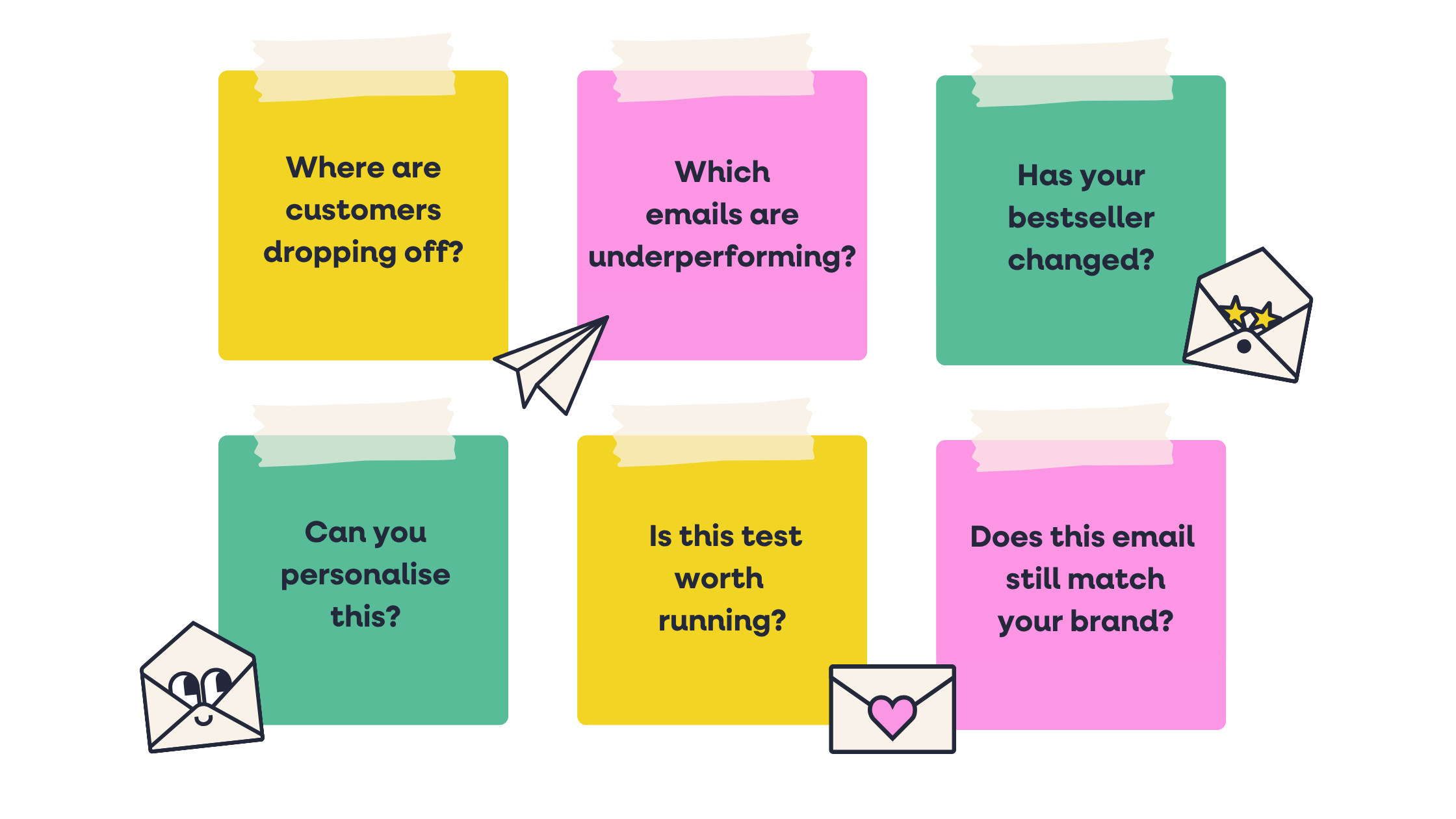
How do you know which Klaviyo flows need optimising?
Don't open Klaviyo and start randomly changing things.
Start with the data.
Look at your flows as a customer journey rather than a collection of individual emails.
Where are people buying?
Where aren't they?
Where does performance suddenly drop?
Which flows are generating a decent amount of revenue, but could potentially generate more?
Which emails are getting plenty of opens but bugger-all clicks?
Those are your clues.
Here are some of the things I'd look at.
1. Find where customers are dropping off
Start by looking at the individual emails inside each flow.
Let's say your five-email welcome flow looks something like:
Email 1: Loads of clicks + orders
Email 2: Still looking healthy
Email 3: 👀
Email 4: Tumbleweed
Email 5: Barely contributing anything
Don't immediately delete emails 3–5.
Ask why.
Has the content become repetitive?
Are you asking them to buy five times without giving them another reason to care?
Is there an objection you haven't answered?
Does someone need more help choosing the right product?
Could the timing be wrong?
The drop-off tells you where to investigate. It doesn't necessarily tell you what the answer is.
That's where strategy comes in.
2. Look beyond open rates
Open rates are useful, but they don't tell you whether an email is actually doing its job.
For e-commerce brands, I want to know what happens after the open.
Are people clicking?
Are they placing orders?
How much revenue is the email generating?
How does that compare with the other emails in the flow?
An email with a gorgeous open rate and very few clicks might have a cracking subject line and content that isn't doing enough once someone gets inside.
Don't optimise the number that looks easiest to improve. Optimise for what the email is actually supposed to achieve.
3. Check that you're still showing the right products
This is such an easy one to miss.
You built your welcome flow 18 months ago and proudly added your three bestselling products.
Are they still your three bestselling products?
Maybe another collection has taken off.
Maybe you've launched something that's become the obvious first purchase.
Maybe something you're heavily featuring is now constantly out of stock.
Maybe customer buying behaviour has completely changed.
Your automated emails should reflect the business you have now, not the business you had when someone originally built them.
4. Look for easy ways to personalise the journey
Personalisation doesn't have to mean creating 400 versions of every email.
Sometimes it's simply asking:
Do all of these people need the same thing?
A first-time customer and a fifth-time customer probably don't.
Someone browsing dresses and someone browsing knitwear have given you different signals.
A customer who only ever shops during a sale may respond differently from someone who happily buys full-price.
A gift buyer might need completely different post-purchase content from the person actually using the product.
You already have loads of customer behaviour sitting inside Shopify and Klaviyo.
Use it.
Even one or two meaningful splits can make a flow feel far more relevant without creating an absolute monster that nobody wants to manage.
5. Check whether your emails still sound like you
This one isn't sitting neatly inside a Klaviyo dashboard.
But it matters.
Go and actually read your automated emails.
Especially the old ones.
Does the copy sound like your brand now?
Are you still talking about products you barely sell?
Have your USPs changed?
Are old offers lurking in there?
Does the design match your current website?
Would you be happy if someone discovered your brand today and this was their first proper introduction to you?
Remember, these emails could be getting seen by hundreds or thousands of people every month.
Don't let them become a time capsule from your 2023 brand era.
6. Stop A/B testing things for the sake of A/B testing
I love a test.
I do not love:
“Let's test a blue button against a slightly darker blue button and wait six months for a statistically useful answer.”
Before you run an A/B test in Klaviyo, ask:
If B wins, will we actually care?
Test things that could meaningfully change customer behaviour.
The offer.
The angle.
The timing.
The number of emails.
The product recommendation.
The CTA.
The type of content.
And make sure you've actually got enough people going through the flow to learn anything useful.
A test isn't an optimisation just because Klaviyo lets you set one up.
7. Look for the missed opportunity in your BEST flows too
This is one people forget.
Optimisation isn't just fixing things that are broken.
Sometimes your biggest opportunity is something that's already working really bloody well.
If one flow is generating a chunky percentage of your automated revenue, ask:
Why?
What is working there?
Could you get more eligible people into it?
Could the winning message be used elsewhere?
Could you add a useful follow-up?
Could you personalise it further?
Good performance isn't always a signal to leave something alone. Sometimes it's a clue that you've found something worth doing more of.

How often should you optimise your Klaviyo flows?
You don't need to spend every Friday afternoon fiddling with your welcome flow.
You need enough data to make sensible decisions.
For most established Shopify brands, I'd recommend regularly reviewing your core flows rather than waiting until something obviously goes wrong.
The exact frequency depends on how much traffic and order volume you have. A brand putting thousands of people through its flows every month can learn much faster than one getting a handful.
But I'd want your core flows reviewed throughout the year, with a deeper look whenever something significant changes in the business.
New website?
Big product launch?
New bestseller?
Change in offer?
Peak trading period coming up?
Go and check what your automated emails are telling people.
A simple Klaviyo flow optimisation checklist
If you've got Klaviyo open in another tab, here's where I'd start.
✅ Look at how much revenue your flows are generating overall
✅ Find your highest and lowest-performing flows
✅ Compare the individual emails inside each flow
✅ Look at clicks, conversions and revenue, not just opens
✅ Check where performance drops off
✅ Review the products and offers you're featuring
✅ Read the emails and check the copy still sounds like your brand
✅ Look for customer groups that deserve a different journey
✅ Check any existing A/B tests are actually teaching you something useful
✅ Pick ONE meaningful thing to improve first
You don't need to rip the whole account apart every month.
Find the biggest opportunity. Improve it. Collect more data. Then go again.
Building your Klaviyo flows isn't the finish line
Getting your core email flows built is a brilliant start.
But that's what it is: the start.
The brands getting the most from Klaviyo aren't necessarily the ones with the most flows.
They're the ones paying attention to what their customers are doing and using that information to make the journey better.
Again and again.
Because once you've got enough automation in place, more isn't always the answer. Better often is.
Want someone else keeping an eye on all this?
Knowing you should be checking your flows is one thing.
Actually finding the time to dig through the data, work out what matters, decide what to change, test it and then come back to see whether it worked?
That's another job on your list.
Inside The Full Send, our UK-based team manages your Klaviyo account for you.
That means we're not just planning, writing, designing and sending your campaigns. We're keeping an eye on what's happening behind the scenes too, spotting opportunities and continually improving the customer journey as your brand grows.
So your email marketing doesn't just get done.
It gets better.